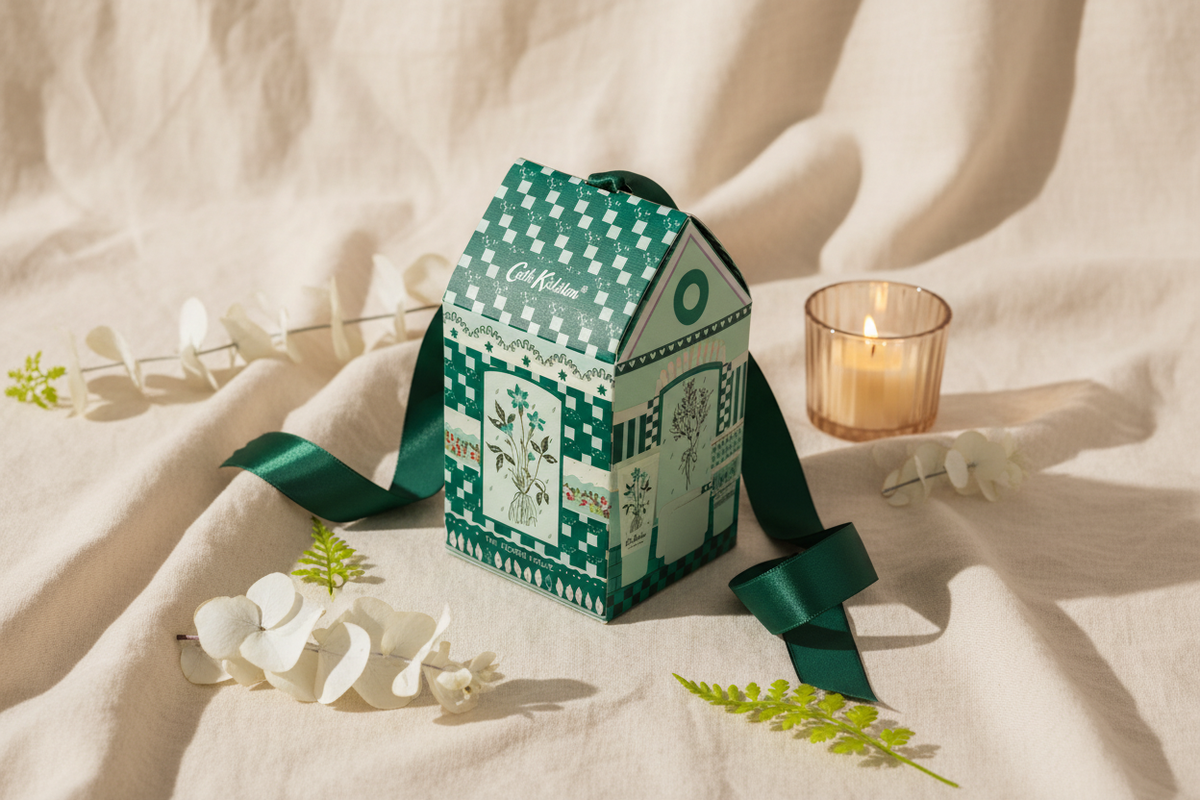
A gift box styled with botanical sprigs, ribbon and candlelight at The Rowan Tree

Here's something we've noticed after years behind the counter: almost nobody comes into a gift shop looking for a thing. They come in looking for a feeling. “Something that says thank you, but properly.” “Something for my mum, who never treats herself.” “Something for a friend who's had a rough year.”

The object is just the vessel. What people are really trying to give is attention, gratitude, comfort, love. That's what this guide is about. Not a list of products (though we'll point you to a few, honestly and sparingly), but a proper look at why humans give gifts at all, what giving does for the giver, and what the research says about choosing well.

Make a cup of tea. This one's worth reading slowly.

Why we give gifts at all

Gift-giving is older than money, older than writing, possibly older than language as we know it. Every human culture ever studied does it. In the 1920s the French anthropologist Marcel Mauss looked at gift traditions across the world, from Polynesian exchange rituals to Native American potlatch ceremonies, and noticed something that still rings true at a birthday party in Devon: a gift is never just an object. It carries something of the person who gives it.

Mauss described gifting as a cycle with three parts: the obligation to give, the obligation to receive, and the obligation to give back. That sounds transactional, but it's the opposite. The point of the cycle is that it never closes. A gift creates a small, pleasant imbalance between two people, a thread of connection that says we're not done with each other. Debts get settled and forgotten. Gifts keep relationships in motion.

This is why a gift can do what a bank transfer never could. When you give someone a scarf, a candle, or a slightly ridiculous soft toy octopus, you're not moving value around. You're saying: I spent some of my finite time on Earth thinking specifically about you. There's no app for that.

What giving gives back to you

Here's the quietly wonderful part: the science suggests the giver often gets more out of a gift than the recipient does.

In a study published in Science, psychologists Elizabeth Dunn, Lara Aknin and Michael Norton gave people money and told half to spend it on themselves and half to spend it on someone else. The second group ended the day measurably happier, and the amount didn't matter. Five dollars spent on another person outperformed twenty spent on yourself. Follow-up research found this “warm glow” of giving in countries rich and poor, and even in toddlers, who show more delight giving treats away than receiving them.

Economists call it warm glow. Most of us know it as the feeling of watching someone's face while they unwrap something you got right. Part of it is anticipation: choosing a gift forces you to pause and think hard about who someone actually is, what they love, what they're missing. That act of attention is a form of closeness in itself, and it happens before the gift is even wrapped.

So if you've ever suspected you enjoy giving presents more than getting them, you're not odd. You're human, and the data is on your side.

A lit double-wick candle creating a calm atmosphere, from The Rowan Tree

Gifts as messages: identity and belonging

Every gift says three things at once: something about you, something about them, and something about the relationship between you. That's why choosing one can feel strangely high-stakes. It is a message, and we all know it.

Psychologists who study gifting talk about it as an act of symbolic communication. A well-chosen gift says “I see you”, and being accurately seen is one of the deepest human pleasures there is. Think about the best gift you've ever received. We'd bet it wasn't the most expensive one. It was the one that proved someone had been paying attention: the book by the author you mentioned once in passing, the mug that replaced the chipped one you refused to throw away.

Gifts also shape identity in a subtler way: they tell us who we are to other people. Being the friend who always finds the perfect card, the aunt who sends the birthday parcel that actually arrives on time, the colleague who remembered the leaving do — these small roles become part of how we see ourselves. Generosity, practised often enough, stops being a behaviour and becomes a character.

And the objects themselves keep working long after the wrapping paper's recycled. A throw on the sofa, a print on the wall, a teapot used every Sunday: each one is a little ambassador for the person who gave it. Homes fill up with these quiet reminders that we are known and loved. That's not clutter. That's a support network you can dust.

What the research says about gifting well

Gift-giving has been studied surprisingly thoroughly, and the findings are freeing, because most of what we stress about turns out not to matter. Here's what does.

1. Spend less worry (and often less money)

Research by Francis Flynn and Gabrielle Adams found essentially no relationship between how much a gift costs and how much the recipient appreciates it. Givers assume price signals thoughtfulness; recipients barely register it. A £15 gift chosen with care routinely beats a £75 gift chosen in a hurry. (We say this as a shop that would quite like to sell you the £75 one.)

2. It's fine to ask them what they want

Studies by Francesca Gino and Francis Flynn found that people are more appreciative of gifts they asked for, not less, yet givers keep avoiding the wish list because surprise feels more romantic. If you want both, ask for the category and surprise them within it. They said “something cosy”? The choice of which throw is still yours, and so is the credit.

3. Think about the week after, not the moment of unwrapping

Research led by Jeff Galak at Carnegie Mellon identified the classic giver's mistake: we optimise for the reveal, the gasp, the “wow”. Recipients, meanwhile, value what a gift is like to own: how useful, how comforting, how often it earns its place. The showstopper gets admired once. The beautiful everyday thing gets used four hundred times a year and thinks of you every time. When torn between impressive and useful, choose useful and wrap it impressively.

4. Sentiment lands harder than you think

Work by Amit Kumar and Nicholas Epley shows we consistently underestimate how much warm words mean to people, which is why so many of us scribble “Happy Birthday, love M” and leave it there. The card is not the admin attached to the gift. Done properly, it's the half people keep. Write the sentence you'd feel slightly embarrassed saying out loud. That's the one.

5. Presentation is part of the gift

Unwrapping is a small ceremony, and ceremony tells the brain this matters. Real ribbon, a handwritten tag, the gift inside a decent bag: thirty seconds of effort that changes how the whole thing is received. It's also the cheapest upgrade in all of gifting.

The gifting gap: what givers fret about vs what recipients remember

An illustration of the pattern found across consumer research (Galak, Givi & Williams; Flynn & Adams).

What it cost
Givers worry about it constantly
Recipients: barely
The “wow” at unwrapping
Givers optimise for this moment
Recipients: nice, soon forgotten
How useful it is months later
Givers undervalue this
Recipients value it enormously
Feeling truly known
Givers underestimate it
Recipients: the whole point

A simple framework for choosing

When someone's stuck, we ask them three questions at the counter. They work every time.

🎉
The occasion Why are you giving? A milestone wants a keepsake; a thank-you wants warmth, not weight.
❤️
The person Not “what do they like” but “what have I noticed about them lately?”
The feeling What should it say? “Rest.” “I'm proud of you.” “I remembered.”
The five-question gift check

Before you buy, run it past these:
1. Does it show I've noticed something specific about them?
2. Will they still be using or enjoying it in three months?
3. Is it for their taste, or secretly for mine?
4. Would it survive without the story? (If it needs a long explanation, it may be a gift for you.)
5. Have I left five minutes to wrap it properly and write a real card?

Elegant wedding gifts wrapped and styled at The Rowan Tree

Mistakes we all make (shopkeepers included)

Gifting your own taste. The jazz records you'd love them to love. The scent you'd wear. The surest sign is a little voice saying “well, if they don't want it…”

Confusing big with meaningful. A grand gesture chosen in a panic reads as panic. A small thing that references a shared joke reads as love.

The gift that's really a hint. Kitchen scales for someone who “should cook more”. Running socks for someone who mentioned the gym once, in 2023. If a gift contains advice, the advice is all they'll unwrap.

Overthinking the “perfect” gift into paralysis. Perfect is not the standard. Chosen with them in mind is the standard, and it's much easier to hit.

Skipping the card. See point four above. The words are half the gift. Sometimes they're most of it.

A word on gifting yourself

One more thing, because it comes up at the counter more often than you'd think, usually said sheepishly: “…and this one's for me.”

Good. Marking your own milestones matters too. You finished the course, survived the house move, got through a hard month. Nobody else saw exactly what it took, which means nobody else can mark it properly. A small deliberate treat isn't indulgence; it's evidence that you noticed your own effort. The rules above still apply, especially question two: choose the thing future-you will keep reaching for.

If you'd like a head start

Everything above works wherever you shop. But since you're here: we're a small independent gift shop, every item on our shelves was chosen by an actual person (usually while Smudge supervised), and we've organised the range around the way people actually think about gifts. Start wherever matches the question in your head.

“It's for an occasion”:

“It's for a person”:

“It needs to say a feeling”:

“I have a budget in mind” (remember: price ≠ thoughtfulness):

Still stuck? Try our Gift Finder, which walks you through the same questions we'd ask in the shop. Or just phone us on 01395 446066, seven days a week, and describe the person. Recommending gifts is our favourite part of the job.

Gifting questions, answered

How much should I spend on a gift?

Less than you're worrying about. Research consistently finds no link between a gift's price and how much it's appreciated, so spend what the relationship and your budget comfortably allow, then invest the savings in choosing well and wrapping properly. A considered gift under £25 beats an expensive afterthought every time.

Is it better to surprise someone or ask what they want?

Ask. Studies show people appreciate gifts they've requested more than surprises, even though givers assume the opposite. If you love surprises, keep the category they asked for and surprise them on the specifics, the quality, or the presentation.

What makes a gift feel thoughtful?

Specificity. A thoughtful gift contains evidence that you noticed something particular about the person: a comment they made, a habit they have, a thing they'd never buy themselves. It shows in the choice, and it shows even more in the card you write to go with it.

What should I do if I don't know the person very well?

Choose a small luxury in a universally pleasant category: a beautiful candle, quality chocolate, lovely stationery, fine soap. These are things almost everyone enjoys but rarely buys for themselves, and they don't presume intimacy the way personal items do. Present it well and keep the note warm but simple.

Is giving money or a voucher a cop-out?

Not always. For teenagers, weddings, or someone saving toward something specific, money is often exactly right. It only feels flat when it stands in for attention you could have paid. If you give a voucher, pair it with a small chosen item and a proper card so there's still something of you in it.

What's a good last-minute gift that doesn't feel last-minute?

Something consumable and sensory, wrapped beautifully, with a handwritten card that references something real between you. Nobody ever asks how long a gift took to find; they only feel how well it fits. Ten sincere minutes reads as weeks of planning.

The best gift you'll give this year probably won't be the biggest one. It'll be the one where someone unwraps it, goes quiet for a second, and says: “How did you know?”

You knew because you paid attention. Everything else is just wrapping.

— Michael, Smudge & the team at The Rowan Tree

Browse the shop